First real heat wave of the year hits, you turn on the AC, and the air coming out of the vents is room temperature. Or warm. Or the unit isn't running at all.
Most of the time, an
AC not blowing cold air is caused by one of six common issues. Some take less than two minutes to fix yourself. Others need a licensed technician. This guide walks through each cause in the order we recommend checking them, plus what to do if none of them solve the problem.
Advantage Airtech ClimateCare has been keeping Durham homes cool since 1987. These are the fixes we see most often when a Pickering, Ajax, Whitby, or Oshawa homeowner calls about an AC that isn't doing its job.
The quick answer
If your AC isn't blowing cold air, check these three things first:
Your thermostat (set to COOL, temperature below room temp), your air filter (replace if dirty), and your outdoor condenser unit (powered on, debris cleared, fan spinning). If all three check out and you're still getting warm air, you likely have a refrigerant issue or a failed component — time to call a technician.
1. The thermostat is set wrong
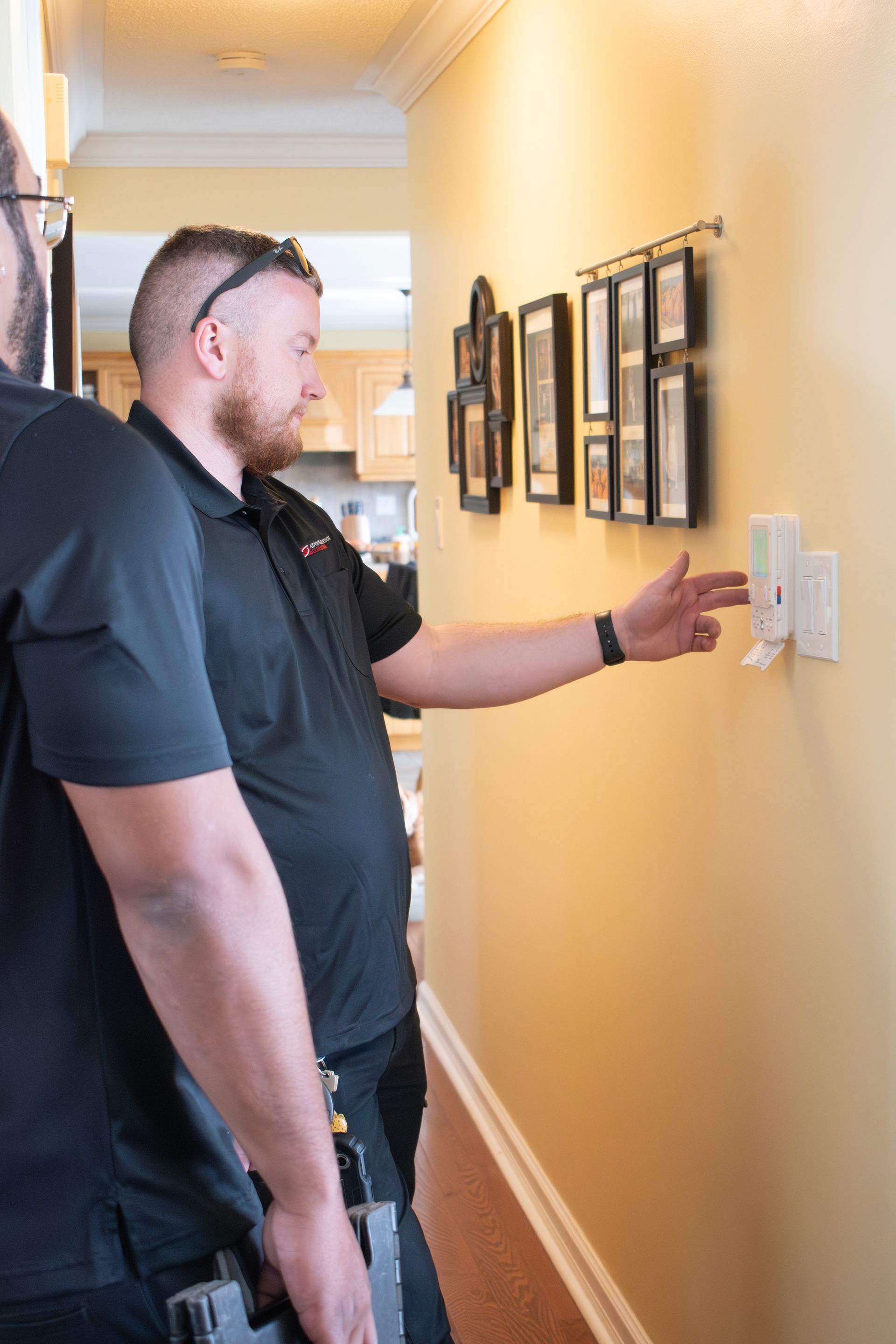
This is the most common cause, and it's a 30-second fix. A few things to check on the thermostat itself:
•
Mode is set to COOL, not HEAT, AUTO, or FAN
•
Temperature setpoint is at least 3-5 degrees below current room temperature
•
Fan is set to AUTO, not ON
(when set to ON, the fan runs continuously even between cooling cycles, so you'll feel warm air during those gaps)
•
Batteries are fresh (on battery-powered thermostats a dying battery can cause erratic behaviour)
What to check:
Walk to your thermostat. Confirm all four settings above. Wait about 10 minutes, most central AC systems have a
built-in compressor delay of 3-5 minutes before cooling starts. If you still feel only warm air after 10 minutes, move on to the next cause.
3. The outdoor condenser unit isn't running
Your central AC has two parts: an indoor unit (usually attached to the furnace) and an outdoor unit (the metal box with the big fan, usually beside your house). If the outdoor unit isn't running, you'll feel air at the vents but it won't be cold — just the indoor blower moving air without any actual cooling happening.
Common reasons the outdoor unit isn't running:
•
The disconnect switch beside the unit has been turned off (sometimes accidentally during yard work or by a landscaper)
•
The breaker for the AC has tripped in your electrical panel
•
Debris is blocking the fan — leaves, branches, or grass clippings
•
The capacitor has failed (a common AC component failure, especially in units over 5 years old)
What to check:
Walk outside to your condenser unit. Listen for the fan. If it's silent, check the disconnect switch on the wall beside the unit (small grey box, switch should be in the ON position). Then check your electrical panel for a tripped AC breaker. Clear any debris within two feet of the unit.
When to call a pro:
If the disconnect and breaker are both on, no debris is blocking the unit, and the fan still isn't running, the most likely cause is a failed capacitor. Capacitors are inexpensive to replace but they store electrical charge and need to be handled by a qualified technician.
4. The system is low on refrigerant
Refrigerant is the chemical that makes cooling possible — it absorbs heat from indoor air and releases it outside. If your refrigerant level is low, the system will still run but produce little or no cold air. You might also hear a hissing sound or notice ice forming on the refrigerant lines. Important: AC systems are sealed. You should never need to add refrigerant to a properly functioning unit. If refrigerant is low, it means there's a leak somewhere — and topping it up without fixing the leak is just an expensive temporary patch.
What to check:
You can't measure refrigerant levels yourself. Signs that point to low refrigerant include: ice on the outdoor copper lines, hissing or bubbling sounds, cooling that's gotten weaker over months or years, or an outdoor unit that runs constantly without cooling the house effectively.
When to call a pro:
Refrigerant work requires a licensed technician. In Canada, only certified technicians can handle refrigerants under environmental regulations. If you suspect a leak, get it diagnosed before the system damages itself running on a low charge.
5. The evaporator coil is frozen
This is a symptom rather than a root cause — a frozen evaporator coil is usually caused by one of the issues above (low refrigerant, dirty filter, or restricted airflow). But it deserves its own callout because the symptoms are distinct and the immediate fix is different.
When the evaporator coil (the indoor coil, usually above the furnace) freezes, ice builds up to the point where no air can pass through. The system blows almost nothing at the vents, or what little air comes out is warm. You might also see condensation or water damage around the furnace from the ice melting.
What to check:
Turn off cooling at the thermostat but switch the fan to ON. This circulates room-temperature air across the coil and helps it thaw faster. Give it 2-4 hours. After thawing, replace the filter (if dirty) and turn cooling back on.
When to call a pro:
If the coil freezes again within 24 hours, you have an underlying issue — almost always low refrigerant or a failing blower motor. Call a technician before running the system again, because a frozen coil that keeps refreezing can damage the compressor.
6. A major component has failed
If you've worked through the first five causes and the AC still isn't cooling, you're likely looking at a failed component.
The most common are:
•
Compressor failure (the heart of the system — if it's failed, the unit may make humming or clicking sounds but won't cool)
•
Contactor failure (the electrical switch that powers the outdoor unit)
•
Blower motor failure (the indoor fan that pushes air through your home)
•
Control board failure (the brain of the system)
These aren't DIY repairs. Some are inexpensive (a contactor is usually a 30-minute job), others are expensive enough to justify replacing the whole unit (a compressor on a 12-year-old system rarely makes financial sense to repair).
When to call a pro:
Always — at this point in the checklist, you've ruled out everything a homeowner can reasonably check.
When to stop troubleshooting and call a technician
Most of the causes above have a DIY check and sometimes a DIY fix. But there are a few situations where you should stop immediately and call a licensed HVAC technician:
•
You hear hissing, bubbling, or whistling sounds from the AC lines
•
You see ice on the outdoor refrigerant lines or the indoor coil
•
You smell anything chemical, electrical, or burning
•
Water is pooling around the furnace or indoor air handler
•
The outdoor unit is making banging, grinding, or screeching noises
•
You've checked the thermostat, filter, and outdoor unit and you're still getting warm air
Refrigerant and electrical components carry safety and regulatory restrictions. The DIY checks in this guide are safe; everything beyond them is not.
Avoid the July rush
Once the first real heat wave hits Durham — usually mid to late June — service calls book out a week or more. If your AC is already showing warning signs (longer cooling cycles, water around the furnace, unusual noises, weaker airflow than last summer), get it diagnosed in May or early June while wait times are still short.
Pre-season tune-ups catch most of the issues that turn into emergency calls in July. A tune-up typically includes a refrigerant level check, coil cleaning, electrical inspection, and capacitor testing — exactly the components most likely to fail under heavy use.